The Exercise "Sweet Spot" for Brain Health After 50: How Much, How Often, What Kind
Sep 01, 2026
Dr. Diane A. Thompson, MD · Evidence-based | Lifestyle Medicine
Introduction
You do not need to train like an athlete to support your memory, balance, or independence. But you do need a movement plan that is regular enough to challenge your cardiovascular system, muscles, and nervous system: without leaving you exhausted or injured. That is the exercise “sweet spot” for brain health after 50: enough movement to stimulate neuroplasticity, cardiovascular health, and confidence, delivered in a way you can sustain.
You are not imagining it if movement feels more important than it once did. Exercise can influence blood pressure, blood sugar, mood, sleep, balance, and the brain’s ability to adapt. It is one of the most practical tools available for healthy aging in an independent-living community, assisted living, or at home.
Table of Contents
1. Why exercise belongs in your brain-health plan
2. How much exercise is the sweet spot?
3. How often should you exercise?
4. What kind of exercise benefits the brain?
5. Why neurorehabilitation adds a brain-training element
6. How to build your weekly movement plan
7. Safety and when to ask for help
1. Why Exercise Belongs in Your Brain-Health Plan
The 2024 Lancet Commission on dementia prevention, intervention, and care identified 14 potentially modifiable risk factors associated with dementia. Together, these factors: including physical inactivity, high blood pressure, hearing loss, diabetes, depression, social isolation, and high LDL cholesterol: are linked to approximately 45% of dementia cases worldwide that could potentially be prevented or delayed.
That statistic does not mean exercise alone prevents dementia. It means your daily habits can influence your long-term risk, and physical activity is one important part of a larger lifestyle medicine approach.
Exercise supports brain health through several pathways:
- Improved blood flow: Your brain depends on a steady supply of oxygen and nutrients.
- Better vascular health: Regular movement can help manage blood pressure, cholesterol, and blood sugar.
- Neuroplasticity: This is your nervous system’s ability to adapt, learn, and reorganize: like updating the brain’s wiring.
- Neurotrophic support: Exercise may influence factors such as BDNF, or brain-derived neurotrophic factor, which helps support neurons and connections between them.
- Improved mood and sleep: Both are essential for attention, memory consolidation, and emotional resilience.
- Greater physical reserve: Stronger legs, better balance, and improved endurance help you remain independent.
The Key
Exercise is not just about fitness or appearance. It is a way to protect the systems that support autonomy, mobility, and cognitive function.
2. How Much Exercise Is the Sweet Spot?
There is no single magic number. Your best dose depends on your current fitness, medical history, medications, balance, joint health, and goals.
Still, research provides a useful target.
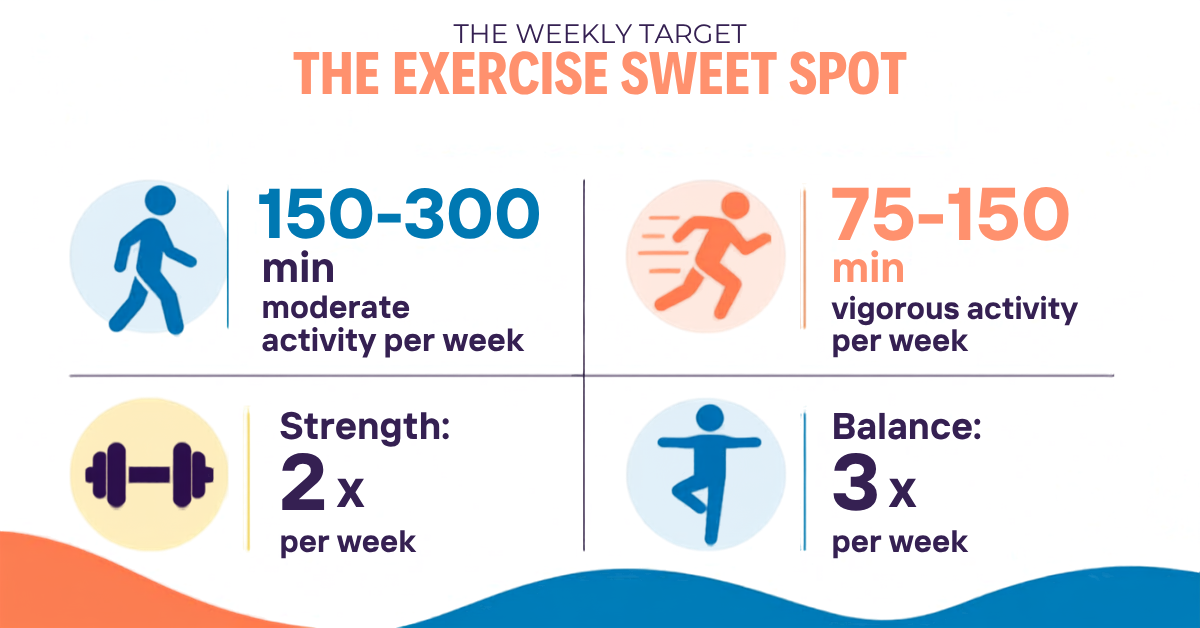
The World Health Organization recommends that adults 65 and older aim for:
- 150–300 minutes of moderate-intensity aerobic activity per week, or
- 75–150 minutes of vigorous-intensity activity per week, or
- An equivalent combination of moderate and vigorous activity.
- Muscle-strengthening activity on at least two days per week.
- Balance-focused, multicomponent activity on at least three days per week, particularly when fall risk or mobility limitations are present.
For brain health specifically, a systematic review and Bayesian network meta-analysis of randomized controlled trials involving thousands of older adults found a nonlinear relationship between exercise and cognition. In plain English, benefits may begin at relatively modest doses, and doing more does not necessarily produce proportionally greater cognitive benefits.
The analysis estimated that approximately 724 MET-minutes per week was associated with a clinically relevant cognitive benefit, although exercise type and intensity mattered. A MET is a unit used to describe the energy cost of physical activity. You do not need to calculate MET-minutes to benefit from the research.
A practical interpretation is:
- Always consult your healthcare professional before starting an exercise program.
- If you are inactive, begin with short, frequent bouts.
- Build gradually toward about 150 minutes of moderate activity per week.
- Add strength and balance rather than spending all your time on aerobic exercise.
- Stop treating the guideline as a pass-or-fail test. Some movement is better than none.
3. How Often Should You Exercise?
For your brain and your body, consistency usually matters more than occasional intensity.
A single long walk on the weekend is better than no walk at all. But spreading movement across the week gives you more regular stimulation for circulation, mood, balance, and motor learning.
A strong starting pattern is:
- Aerobic movement: 3–5 days per week
- Strength training: 2–3 nonconsecutive days per week
- Balance and coordination: at least 3 days per week
- Brief movement breaks: throughout the day, especially if you sit for long periods
Many cognitive-exercise trials use sessions lasting 30–60 minutes, approximately three times per week, over 12–24 weeks. That does not mean you must begin with an hour. You can divide a session into smaller blocks:
- 10 minutes of walking in the morning
- 10 minutes of strength or mobility exercises
- 10 minutes of walking after lunch
Your nervous system responds to repetition. A manageable routine repeated week after week is more valuable than an ambitious routine abandoned after two weeks.
Try This
Choose three days this week for a 10-minute walk. Mark them on your calendar. When that feels comfortable, add five minutes every one to two weeks until you are walking for 20–30 minutes at a time.
4. What Kind of Exercise Benefits the Brain?
The best program is not one exercise. It is a combination that challenges different systems.
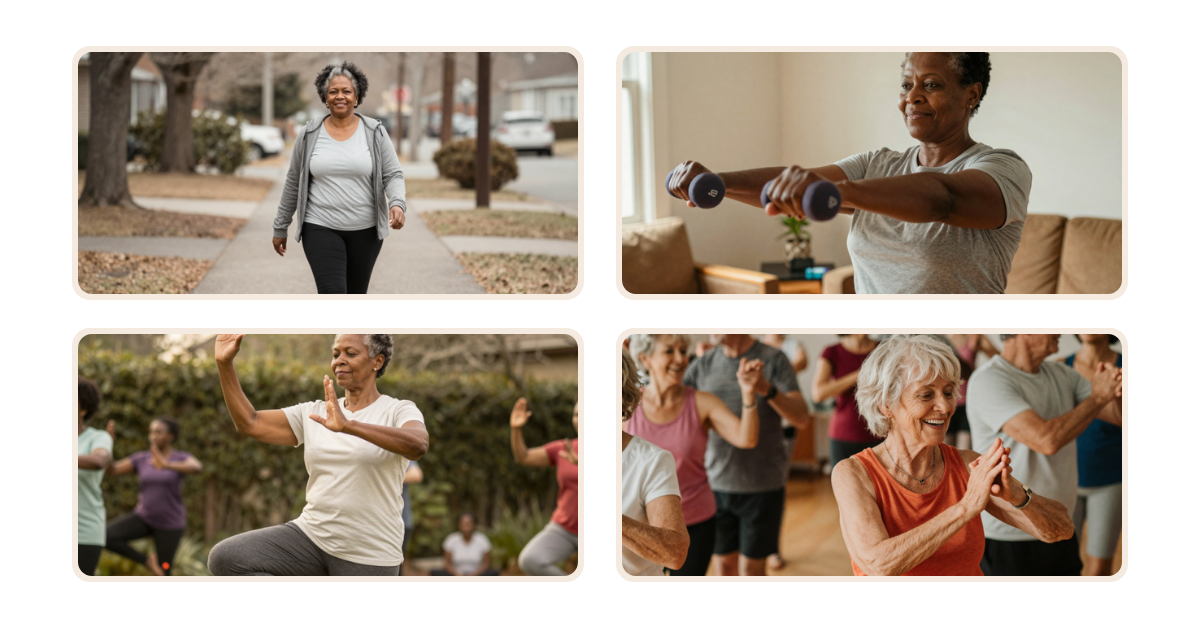
- Aerobic Exercise: Support Endurance and Executive Function
Examples include:
- Brisk walking
- Cycling
- Water aerobics
- Swimming
- Low-impact group fitness
- Dancing
Moderate intensity generally means you can speak in sentences, but singing would be difficult. This is often called the talk test.
Aerobic activity challenges the heart and lungs and may support executive functions such as attention, planning, and processing speed. It also creates opportunities to improve walking confidence and community participation.
- Resistance Training: Protect Strength and Independence
Strength training is essential for brain health because the brain and body are not separate systems. Stronger muscles make it easier to climb stairs, rise from a chair, carry groceries, and recover from a trip or loss of balance.
Options include:
- Resistance bands
- Light dumbbells
- Seated or standing strength machines
- Chair squats
- Wall push-ups
- Heel raises
- Step-ups using a secure step
Aim to train the major muscle groups, especially the legs, hips, back, chest, shoulders, and arms. Begin with a resistance that allows controlled movement and good form.
- Balance Training: Reduce Fall Risk
Balance is a learned skill. It can be practiced and improved.
Examples include:
- Standing with your feet closer together while holding a stable surface
- Heel-to-toe walking near a counter
- Repeated sit-to-stands
- Weight shifting from side to side
- Stepping in different directions
- Tai chi
Always begin balance exercises beside a sturdy support. Do not practice challenging balance drills while alone if you have a history of falls.
- Mind–Body and Skill-Based Exercise: Make Your Brain Adapt
Tai chi, yoga, dance, and choreographed movement combine physical activity with attention, sequencing, rhythm, and coordination. This gives your brain a more complex task than repetitive movement alone.
The challenge should be appropriate: not frightening. When a movement is slightly unfamiliar but still safe, your brain has an opportunity to practice adaptation.
5. Why Neurorehabilitation Adds a Brain-Training Element
Neurorehabilitation uses task-specific, progressive practice to help the nervous system improve function. The same principles can support healthy aging.
Instead of simply saying “exercise more,” ask:
- What skill am I trying to improve?
- Can I make the movement slightly more challenging?
- Can I practice it in a real-life context?
- Can I safely add attention, memory, or decision-making?
This is where dual-task training can be useful. Dual-task training combines movement with a cognitive challenge, such as:
- Walking while naming animals
- Stepping in a pattern while following verbal directions
- Walking with gentle head turns
- Counting backward while performing a supported march
- Dancing while remembering a short sequence
These exercises should be introduced gradually. If adding a cognitive task makes your walking unsafe, return to single-task practice. Safety comes first.
The Key
The brain benefits from movement that is repeated, progressive, meaningful, and slightly challenging: not from movement that overwhelms you.
6. How to Build Your Weekly Movement Plan
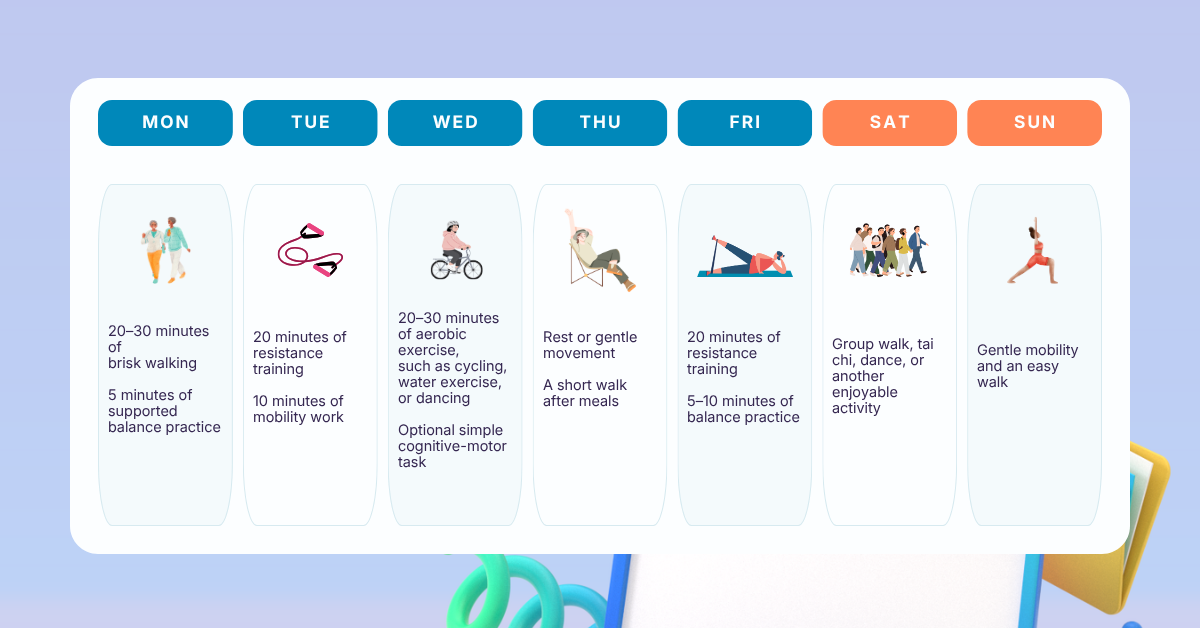
Here is an evidence-aligned template for an independent-living lifestyle:
Monday
- 20–30 minutes of brisk walking
- 5 minutes of supported balance practice
Tuesday
- 20 minutes of resistance training
- 10 minutes of mobility work
Wednesday
- 20–30 minutes of aerobic exercise, such as cycling, water exercise, or dancing
- Optional simple cognitive-motor task
Thursday
- Rest or gentle movement
- A short walk after meals
Friday
- 20 minutes of resistance training
- 5–10 minutes of balance practice
Saturday
- Group walk, tai chi, dance, or another enjoyable activity
Sunday
- Gentle mobility and an easy walk
This plan can be adjusted for arthritis, osteoporosis, Parkinson’s disease, stroke recovery, mild cognitive impairment, cardiopulmonary disease, or other health conditions. Your starting point may be seated exercise, shorter intervals, or supervised training. That is not failure. It is individualized rehabilitation.
For additional brain-health support, explore Dr. Diane Thompson’s Brain Health Power-Up Checklist, sleep-reset resource, and whole-food meal resources.
7. Safety and When to Ask for Help
Before substantially increasing exercise, speak with your healthcare professional if you have uncontrolled blood pressure, chest pain, unexplained shortness of breath, fainting, a recent cardiac event, a new neurological symptom, or a significant balance problem.
Stop exercising and seek medical attention for symptoms such as:
- Chest pressure or pain
- Severe or unusual shortness of breath
- Fainting or near-fainting
- Sudden weakness, numbness, confusion, or difficulty speaking
- New severe dizziness
- Sudden severe headache
A physical therapist, physician, or qualified exercise professional can help you choose safe modifications and progressions.
Start Your 14-Day Brain Reset
Exercise works best when it becomes part of a broader lifestyle. Nutrition, sleep, stress management, social connection, and avoiding tobacco and excessive alcohol all contribute to brain health.
The 14-Day Brain Reset offers one focused, evidence-based action per day to help you build a brain-protective routine. The program includes physician-narrated lessons, a practical work guide, nutrition resources, and a movement lesson focused on neuroplasticity.
The Bottom Line
Your brain does not require a perfect exercise routine. It needs a consistent and appropriately challenging one.
Aim toward:
- 150 minutes of moderate aerobic movement per week
- Strength training at least twice weekly
- Balance and multicomponent movement at least three days weekly
- Gradual progression
- Activities that are safe, meaningful, and enjoyable
Healthy aging is not about proving what you could do at 30. It is about strengthening the capacity you want to use today: and protecting your independence for the years ahead. The next chapter is not an ending. It is an opportunity to move, adapt, and begin again.
This article is for educational purposes and does not replace individualized medical advice. If you have a medical condition, recent injury, or fall risk, consult your healthcare professional before beginning a new exercise program and before making any changes to your health.